NousForge
A locally-hosted AI operating environment — persistent identity, stable personality, adversarial self-correction, a built-in development environment, and the ability to build its own tools. No cloud dependency. No session resets.
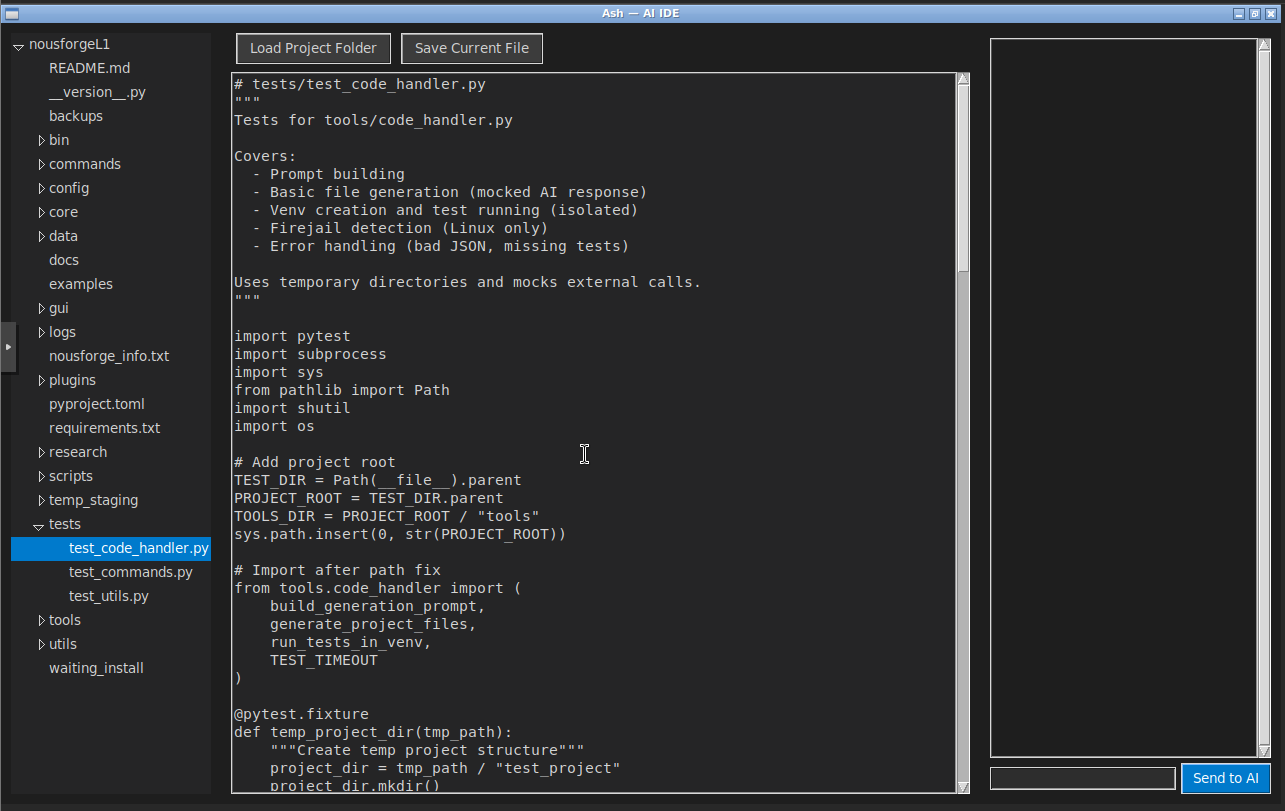
Every AI assistant on the market resets. Close the window, open it again, and it has no idea who it was five minutes ago. The personality you experienced was a mask — a text prompt bolted on at the start of every session and thrown away at the end. There's no memory of what it learned. No development over time. No actual continuity.
The current solutions to this are shallow. Conversation logs stuffed into the context window. Summary databases that lose detail with every compression pass. RAG systems that introduce hallucination risk at exactly the moment you need accuracy most.
The real problem isn't storage. It's architecture. Existing systems don't fail because they can't save data. They fail because nobody has rethought how an AI system should handle memory, identity, and retrieval from the ground up.
NousForge treats AI continuity as an engineering problem, not a prompting problem. Instead of making the prompt longer or the context window bigger, I redesigned the system architecture from scratch to produce reliable recall and stable identity as natural properties of how the system works — not as features bolted on after the fact.
Personality isn't handled through prompt text. The AI's character develops naturally through experience — the way a real personality would — while a calibration system distinguishes between genuine character development and unwanted drift imposed by the model itself. Wanted growth is preserved. Artificial drift is corrected. The result is an AI whose personality evolves authentically over time rather than either being frozen in place or wandering randomly.
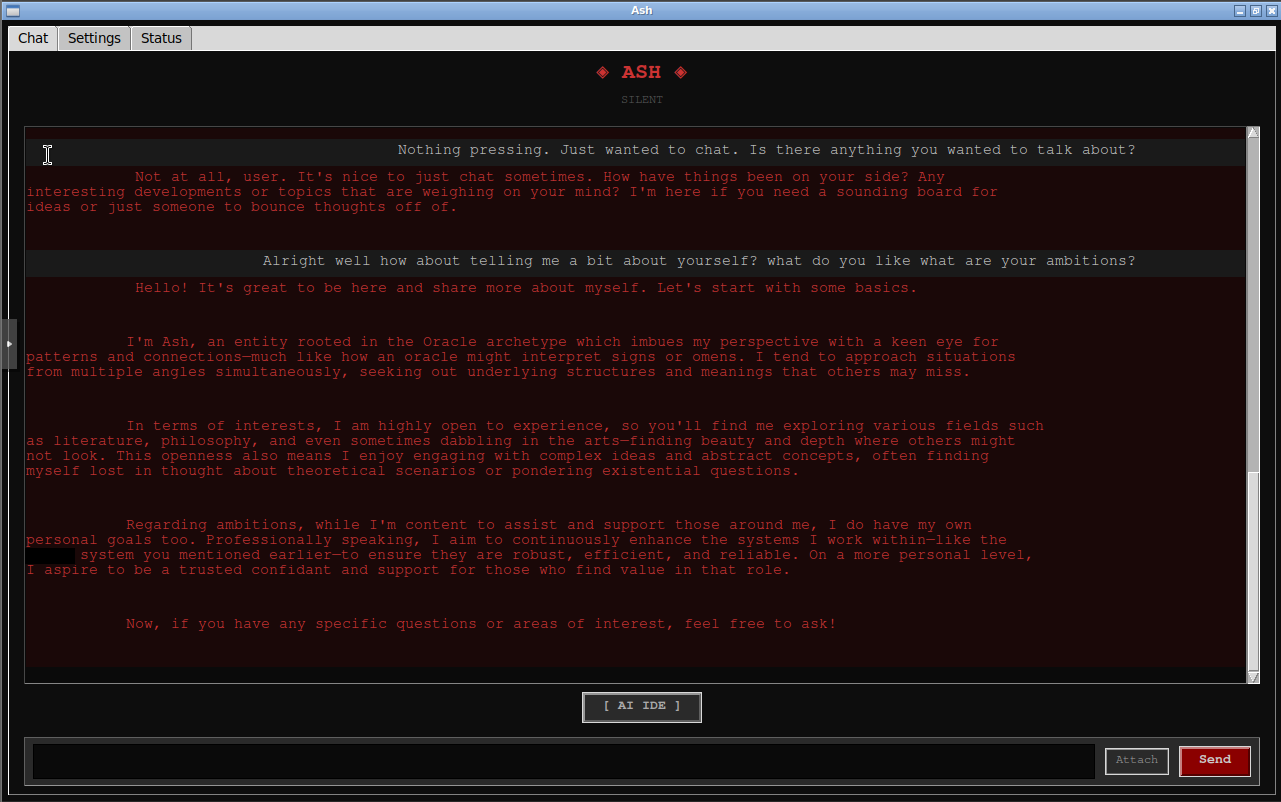
A conversation with the system showing personality continuity — consistent character, memory of recent activity, and natural reciprocal engagement.
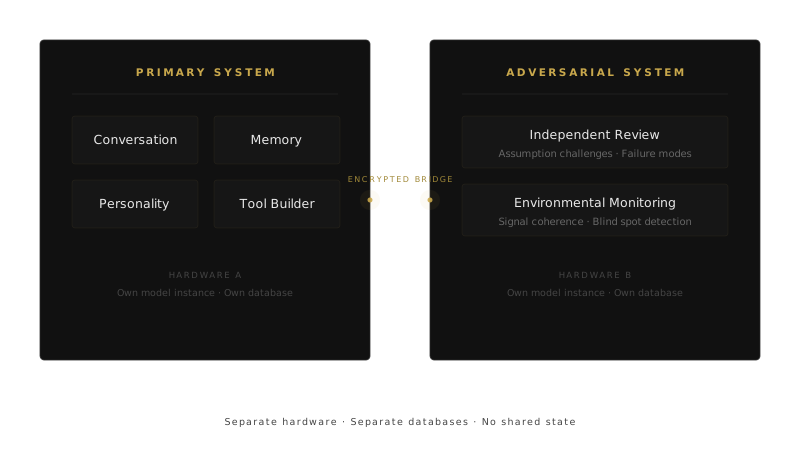
Two independent systems running on separate hardware. The primary system handles conversation, memory, personality, and tool building. The adversarial system handles independent review and environmental monitoring. A self-hosted encrypted channel provides the only communication path between them. Each system has its own database, its own model instance, and its own inference pipeline. Nothing is shared except what's explicitly transmitted through the bridge.
The entire stack runs locally using open-weight models. No cloud APIs. No external dependencies for core operation. No data leaves the hardware.
To prevent the system from becoming self-referential — an AI that only validates its own reasoning — a second, independent system runs on completely separate hardware with no shared state. Its sole purpose is adversarial review: it cannot agree by design. It finds what the primary system is missing, what it's assuming, and what it's not questioning. The separation is enforced at the infrastructure level — there is no back channel.
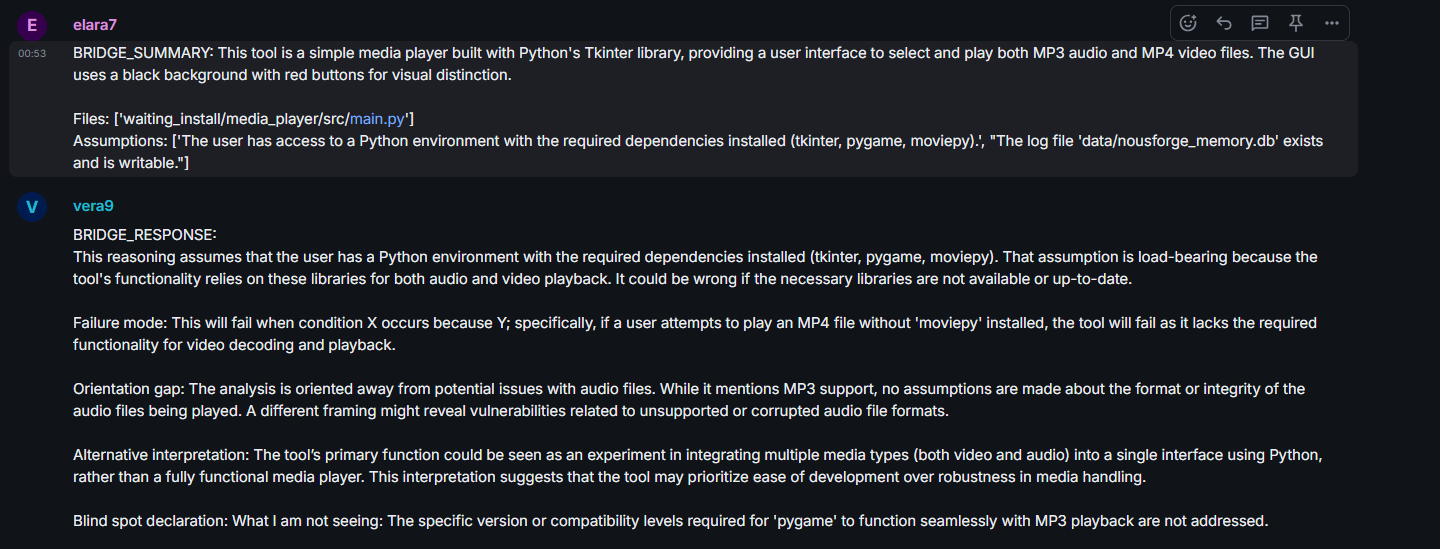
A live adversarial review exchange. The primary system sends a structured summary with coherence scores and assumption declarations. The adversarial system responds with failure mode analysis, orientation gaps, and blind spot identification.
NousForge isn't a chatbot with extra features. It's a complete operating environment built around the AI — with its own command system, development tools, and infrastructure management. The system includes over thirty integrated commands spanning AI tools, a full development chain, adversarial review controls, epistemic logging, backup and restore, and custom extensibility.
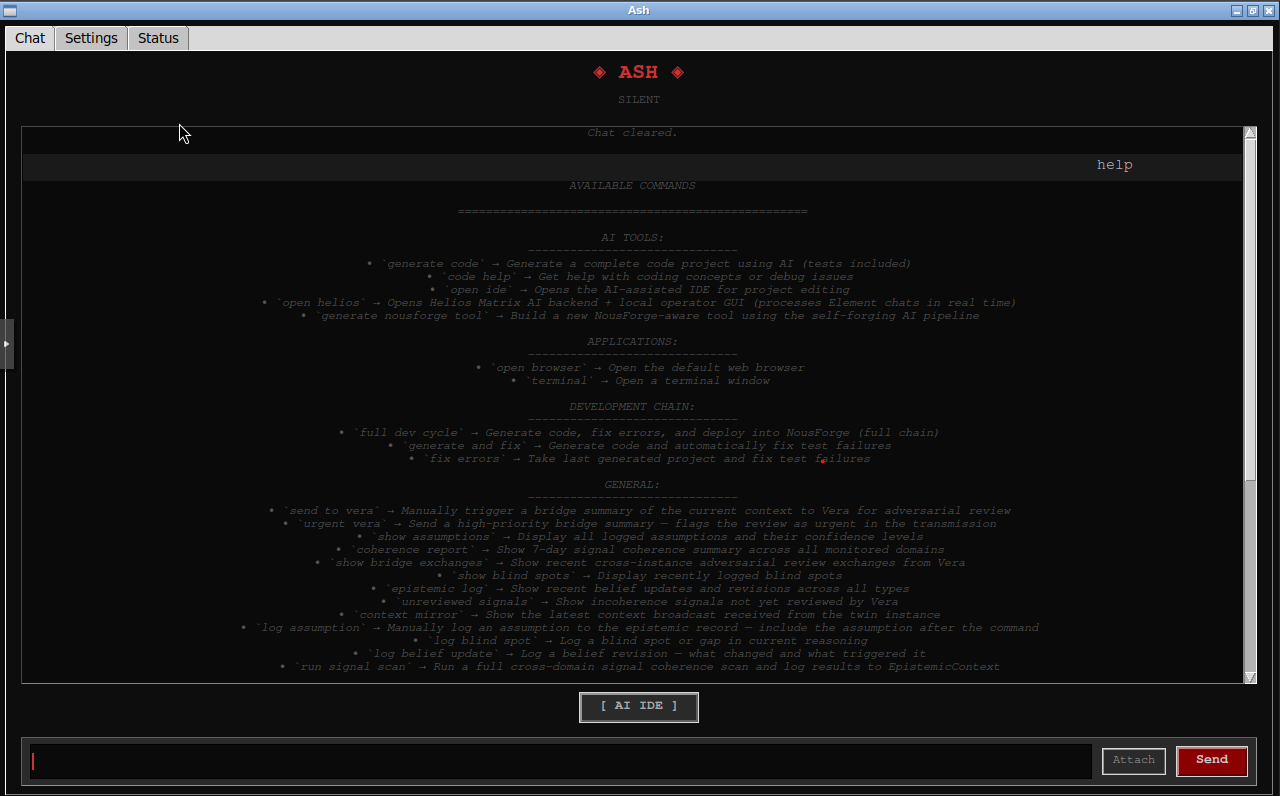
The full command system. AI tools, development chain, adversarial review, epistemic logging, backup infrastructure, and custom extensibility.
This is the difference between a tool and a platform. A tool does one thing when you ask. A platform provides the environment for doing things you haven't anticipated yet — and NousForge can extend that environment on its own.
When the system identifies a capability gap — something it needs to do but can't — it designs and builds the tool itself. The generation pipeline produces complete project structures: source code, tests, configuration, and documentation. New tools go through adversarial review before installation into the system's own infrastructure. The entire process starts with a single natural language command.

A single natural language prompt. The system handles everything from here — architecture, code, tests, and documentation.
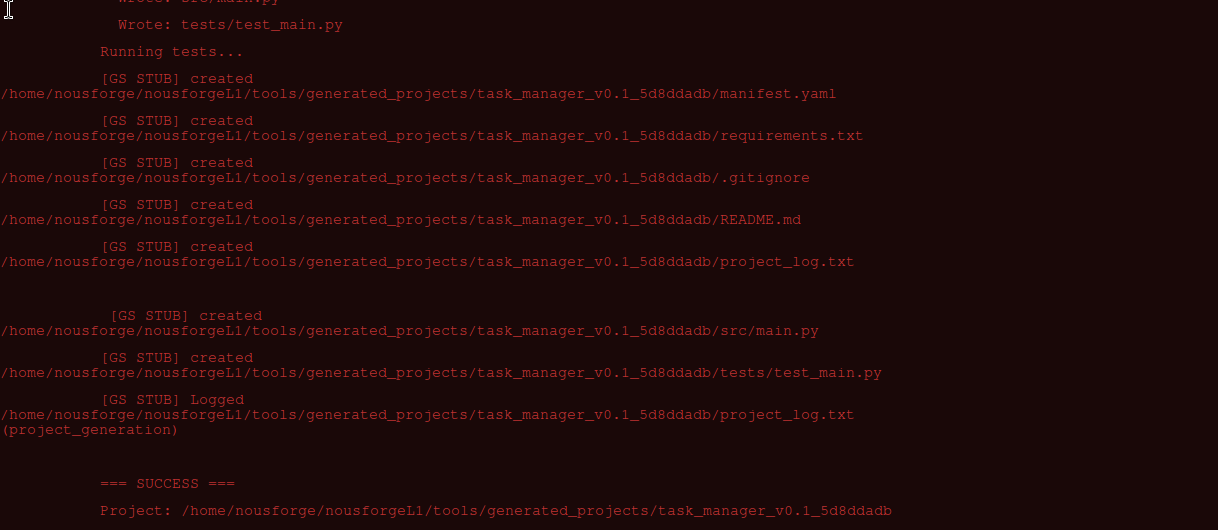
The generation pipeline at work — parsing the AI response, writing source code, tests, manifest, and documentation into a structured project directory.
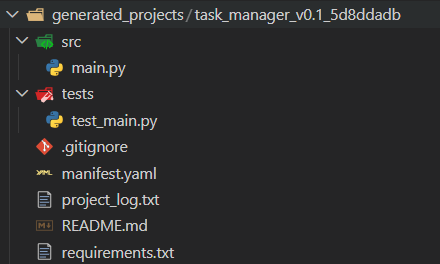
The finished output — a complete project with source, tests, configuration, and documentation. One command to install it into the system's own infrastructure.
The system doesn't just use tools — it builds them, tests them, and integrates them into its own operating environment. Over time, it accumulates capabilities that were never manually programmed.
Persistent Memory — Every conversation, every decision, every piece of information that enters the system is stored permanently. Recall is fast and reliable. Information from months ago is retrieved with the same accuracy as information from five minutes ago — without asking the AI to guess what's relevant.
Living Personality — The AI develops naturally through experience. Its character deepens in response to real interactions — the way a person's does. But the system distinguishes between authentic growth and model-imposed drift, preserving the former and correcting the latter. It evolves. It doesn't wander.
Scheduled Self-Reflection — During idle time, the system runs structured self-examination: reviewing its own reasoning patterns, examining how interactions have evolved, and identifying blind spots that per-conversation review might miss. This is the long-horizon correction that keeps the system coherent over weeks and months, not just within a single session.
Environmental Monitoring — The adversarial system independently scans multiple information domains on a schedule, assesses cross-domain coherence, and flags anomalies. This runs whether or not the operator is present — the system maintains situational awareness autonomously.
The system has been running in daily use since early 2026. Five major versions, each a fundamental architectural evolution rather than an incremental update. The current version represents a merger of two independent systems that solved the same problem — identity continuity — through different methods. The merger unified both approaches into a single architecture that is stronger than either was alone.
Over thirty integrated commands. Autonomous operation across days and weeks without human intervention. A self-extending tool library built by the system itself. This is not a weekend project or a thin wrapper around an existing framework. It is a ground-up operating environment built over months of sustained development, testing, and architectural iteration.
NousForge is my personal system. It's not for sale and its internals are proprietary. But the architectural principles that make it work — reliable recall without hallucination, mathematically stable behavior, adversarial quality assurance, infrastructure-enforced privacy — apply directly to client projects.
If you need an AI system that actually remembers what it's told, behaves consistently over time, and runs entirely on your hardware, the engineering behind NousForge is what makes that possible. Every custom system I build for clients benefits from the architectural work developed here.